Committee on Anti Corruption (CAC)
Committee on Anti-Corruption (CAC) is a Standing Committee of WFEO with the purpose of engaging the worldwide engineering community in the global efforts to fight corruption.
Kamel Ayadi, Chair of CAC / anticorruption(at)wfeo.org
The Tunisian Engineers Order serves as the host of the Committee on Anti-Corruption from 2023 to 2027.
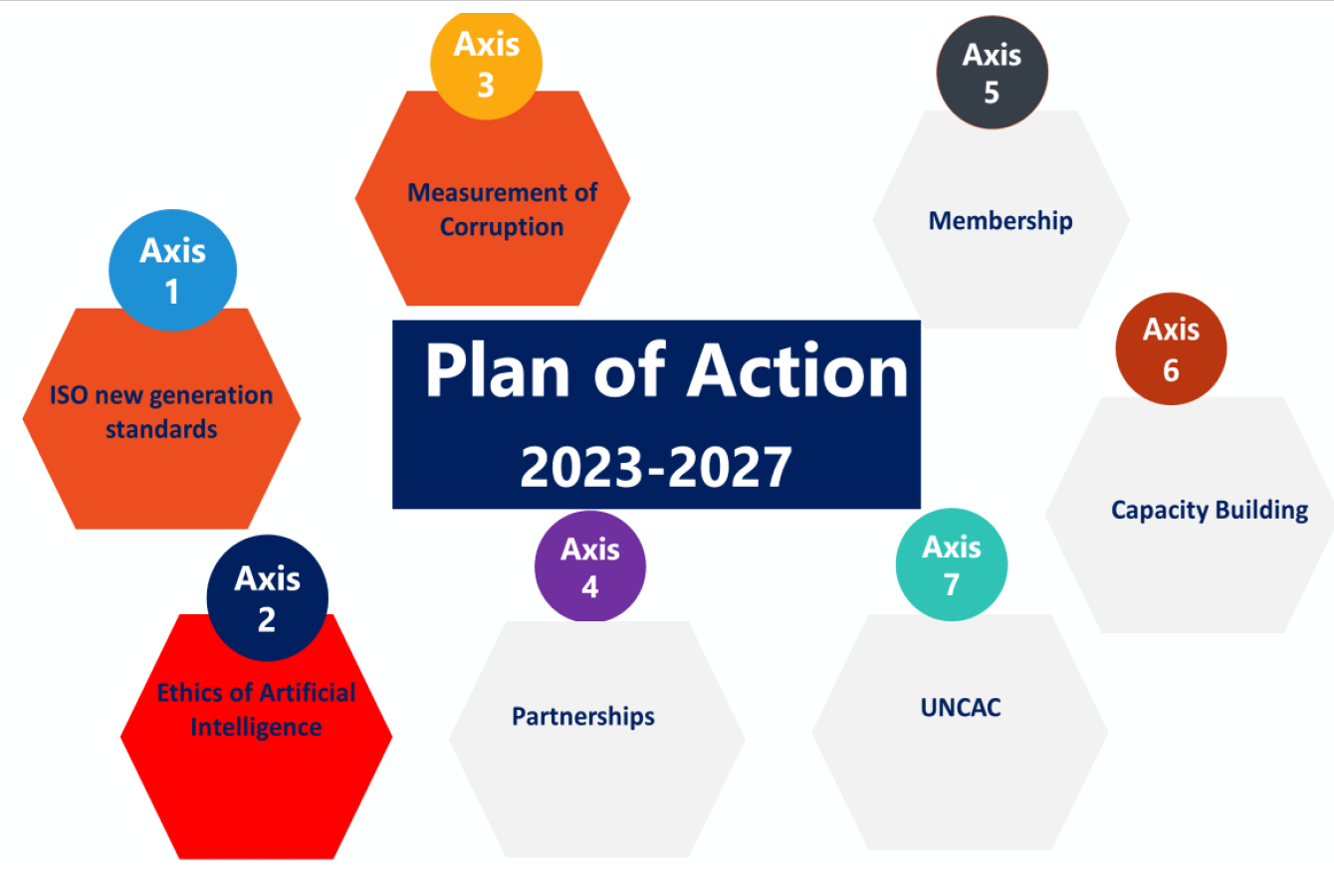
Plan of Action 2023-2027
The Sustainable Development Goals ( UN ) provide a fantastic framework and unprecedented opportunity for the CAC to take action on a large scale. The SDGs explicitly link corruption to peaceful, just, and inclusive societies. SDG 16 and its targets on reducing bribery, strengthening institutions, and access to information are not only valuable aspirations in their own right, but also an important prerequisite for achieving all 17 goals. UNDP’s approach aims to strengthen the participation of professional associations and civil society organizations working in the field of anti-corruption in the implementation of the United Nations Convention against Corruption (UNCAC) through collective action involving governments, civil society and the private sector.
Corruption is one of the most critical issues to address through collective action. There are a variety of ways in which the CAC could build strong partnerships with other actors involved in the fight against corruption, including governments, UN agencies, international organizations, business associations, academia, civil society institutions,etc. Moreover, the fight against corruption has come a long way since the UNCAC was endorsed by most countries. The global fight against corruption has evolved from rhetoric to concrete action, especially with the introduction of new tools such as the Anti-bribery Management Standards and pragmatic anti-corruption strategies. The proposed strategic plan is based on the following actions:
1. Emerging issues
ISO new generation standards:
One of the areas where the WFEO Anti-Corruption Committee can make a significant contribution, and thus increase the visibility and effectiveness of the federation is in standardization activities. WFEO was instrumental in the development of the ISO37001 anti-bribery management standard ten years ago.
Since then, a new generation of standards on governance and corruption has been created or is underway,
including:
- ISO37301 Compliance Management Systems,
- ISO 37000 Guidance for the Governance of Organizations,
- ISO 37002, the new global standard for whistleblowing systems,
- ISO 37003 Fraud Control Management System,
- ISO 37005 Selecting, Creating and Using Indicators, ISO26000 (CSR).
WFEO continues to be heavily involved in the development of a new standard on conflicts of interest. The incoming chair, Kamel Ayadi, is contributing closely to the development of this standard ISO 37009 In the coming years, these standards will be implemented and provide opportunities for engineers to gain expertise. The CAC will form a working group to ensure that WFEO remains strongly committed to the implementation of these standards and the development of new standards.
Ethics of Artificial Intelligence
The challenges associated with artificial intelligence are many. The ethical and social aspects are two of the most important critical challenges that need to be addressed. The numerous warnings issued in recent months by numerous experts about the risks of artificial intelligence and its potential consequences for the future of humanity raise ethical considerations.
Engineers tend to be seen as part of the problem when it comes to the consequences of technological progress for the environment and people. However, they should also be part of the solution. WFEO, as the leading professional organization, should set the tone and provide guidance on how engineers should act to address the consequences of AI.
Although AI falls under the mandate of other committees within WFEO, such as the Information and Communications Committee, the Anti-Corruption Committee is most likely to provide ethical reflection.
Ethics of Artificial Intelligence
The challenges associated with artificial intelligence are many. The ethical and social aspects are two of the most important critical challenges that need to be addressed. The numerous warnings issued in recent months by numerous experts about the risks of artificial intelligence and its potential consequences for the future of humanity raise ethical considerations.
Engineers tend to be seen as part of the problem when it comes to the consequences of technological progress for the environment and people. However, they should also be part of the solution. WFEO, as the leading professional organization, should set the tone and provide guidance on how engineers should act to address the consequences of AI.
Although AI falls under the mandate of other committees within WFEO, such as the Information and Communications Committee, the Anti-Corruption Committee is most likely to provide ethical reflection.
Measurement of Corruption
Measurement is a new issue. Three decades ago, when the anti-corruption movement was in its infancy, measurement became a means of revealing the extent of corruption and its many consequences. Measurement indicators such as Transparency International’s Corruption Perceptions Index and the World Bank’s World Governance Indicator played an important role in advancing the fight against corruption at the global level.
Civil society activists used them to strengthen their advocacy efforts and raise global awareness. These indicators have helped shape the global landscape of corruption. Although their results are questionable and their reliability has been criticized, these indicators shed light on where corruption is widespread. They challenged corrupt countries to do something about corruption to improve their rankings. Three decades later, however, the need for measurement has changed. Local governments need measurements not only to measure the extent of corruption but also, and more importantly, to assess their anti-corruption efforts.
They need measurements to identify integrity gaps and define remedial actions. Global indicators do not provide insight that could help local governments improve their understanding of shortcomings and appropriate solutions to address them. Nowadays, the trend is towards homegrown indicators that are developed and implemented specifically to meet the needs of local governments in adapting their anti-corruption policies. The Anti-Corruption Committee will spend time and resources to develop expertise in the issue of measurement.
2. Classical issues
Partnerships
Establish partnerships with stakeholders active in the field of anti-corruption, such as UNDP, OECD (Integrity Department), Transparency International, World Justice Project (WJP), World Bank, International Organization for Standardization (ISO), anti-corruption agencies, auditors associations, GIACC, Globethics, etc. The extensive connections that the new chair has in each of these institutions will be beneficial in developing partnerships.
Membership
Work with national WFEO members to prioritize anti-corruption in their local and regional agendas. The CAC will work to expand membership to ensure that each national and international WFEO member appoints permanent liaison members. These members will be exposed to the activities of the CAC and thus have the opportunity to expand their knowledge and experience in the field of anti-corruption. In this way, they will act as representatives of the Committee in their own countries. With their knowledge and support from the CAC leadership, these members will be able to lead activities and build partnerships with local actors.
Capacity Building
The Anti-Corruption Committee will undertake activities to assist its members and, beyond them, WFEO’s national and international members in developing capacity to combat corruption. The Committee will devote time and resources to training, especially on emerging topics where members of the federation should strengthen their expertise
The United Nations Conventions against Corruption (UNCAC)
provides a legal framework and policy for governments and civil societies to combat corruption, including corruption prevention, on which the CAC can focus. The CAC will form a special working group whose task will be to join and strengthen relations with the UNCAC coalition.
Kamel Ayadi, Chair of CAC
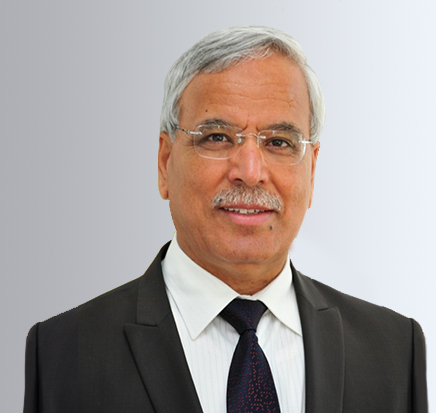
Kamel Ayadi has 38 years of experience in a variety of consulting and leadership positions in the public and nonprofit sectors. He has served at the ministerial level, including as Minister of Governance and Anti-Corruption in the Tunisian government, as Minister to the Head of State, as Chairman of the High-Level Authority for Administrative and Financial Control, as Secretary of State, as Senator, and as founding Chairman of the Telecommunications Regulatory Authority in the early 2000s.
Kamel currently serves as an international consultant on governance, ethics and anti-corruption strategies. He is also a member of the Chandler Sessions on Integrity and Corruption at the Blavatnik School of Government at Oxford University.
Kamel is also a member of the Board of Directors of the World Justice Project (Washington). He is also an advisor to the Chandler Institute of Governance (Singapore). He is the regional consul for the MENA region of the Geneva-based Globethics Foundation. He is the founding chairman of the World Leadership and Ethics Institute, a private institution specialising in training adults in governance, ethics, and anti-corruption. He is also the founding chairman of the Global Infrastructure Anti-corruption Centre in Tunisia.
Kamel was a member of the technical committees of ISO, which were responsible for drafting the ISO37001 anti-corruption management standard, and was subsequently accredited as a certified auditor for ISO37001 anti-corruption and compliance management systems. He is also a member of the technical committees responsible for drafting other ISO standards on conflict of interest and fraud.
Kamel is a certified Dale Carnegie trainer in leadership and management and has extensive experience in training adults in the areas of corruption, ethics, corporate integrity management systems, corporate social responsibility, governance and accountability. He is also a certified facilitator for participatory budgeting and social accountability (United Nations Human Settlements Programme). He has successfully developed and implemented a number of capacity-building programmes in Tunisia and MENA countries.
After holding leadership positions in numerous engineering associations, including president of the Tunisian Order of Engineers (50,000 members), he was elected president of WFEO in October 2003 and was founding chairman of the Standing Committee on Anti-Corruption from 2005 to 2013.
Kamel’s other memberships include: United Nations Global Alliance for ICT Development Strategy Council; United Nations Task Force on Science and Innovation; World Innovation Forum; Pan American Academy of Engineering; American Society of Civil Engineers Committee on Global Principles of Professional Conduct, Brookings Science and Technology Panel for the Arab Report on Science and Technology, co-chair of the Task Force UNESCO, which coordinates the publication of the Engineering Report, United Nations Office of Civil Society for the World Summit on the Information Society.
Kamel has lectured at more than 150 congresses in 80 countries. He has chaired more than 40 international events on science, engineering and technology, anti-corruption, transparency and accountability. He received the President’s Award from the American Society of Civil Engineers in 2011 in recognition of his leadership in the global engineering community and his efforts to fight corruption and serve the country. He has authored several books and reports and conducted research and studies on governance, corruption, and auditing.
Kamel Ayadi holds a master’s degree in civil engineering from the Tunisian National Institute of Engineers and a postgraduate degree in law. He holds a certificate in Business English from the University of Cambridge.
Activities
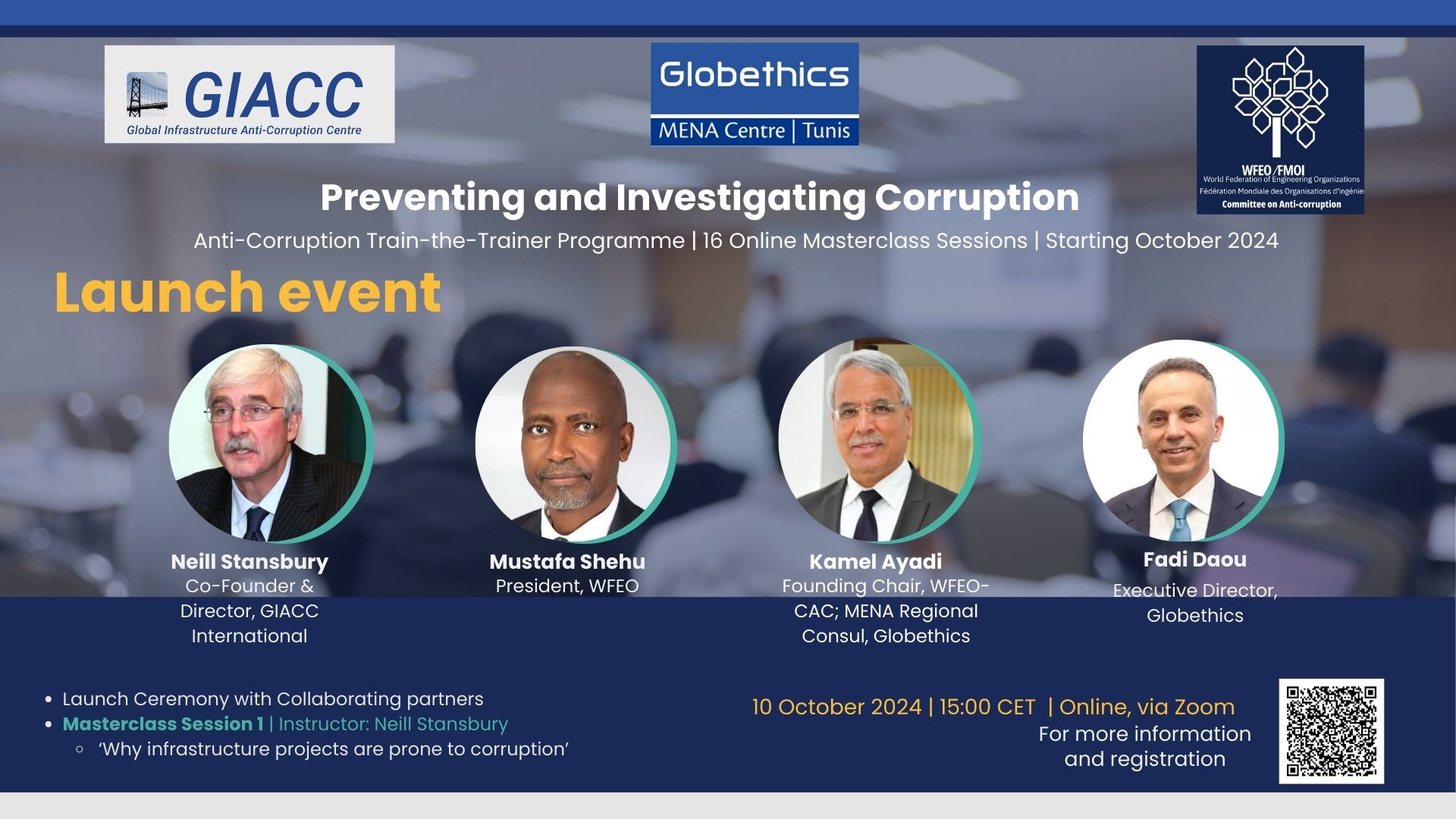
Members
Members list
| Member | WFEO National Member / Institution | Country / Region |
| Ahmed Hesham | Egyptian Syndicate of Engineers | Egypt |
| Amjed Radhouane | Tunisian Engineers Order | Tunisia |
| Anteneh Mitiku | Ethiopian Association of Civil Engineer | Ethiopia |
| Ao Tong Man (Man) | Macau Institute of Engineers (AEM) | Macau, SAR of China |
| Chao Chi Kin (Paul) | Macau Institute of Engineers (AEM) | Macau, SAR of China |
| Charbel Mbarak | Federation of Lebanese Engineers | Lebanon |
| Colin Sheldon | Engineers Australia | Australia |
| Dragan Despotovic | Serbian Chamber of Engineers | Serbia |
| Dragan Zivkovic | Serbian Chamber of Engineers | Serbia |
| Emilio Colon | World Council of Civil Engineers (WCCE) | International |
| Francisco Cordón | Instituto de la Ingeniería de España | Spain |
| James Akanmu | Nigerian Society of Engineers | Nigeria |
| Jean-Michel Le Roux | Ingénieurs et Scientifiques de France | France |
| Jorge Abramian | World Council of Civil Engineers (WCCE) | International |
| Kamel Ayadi (Chair) | Tunisian Engineers Order | Tunisia |
| Laurent Ndalichako | Institution of Engineers Tanzania | Tanzania |
| Leslie Alex Ayeh | Ghana Institution of Engineering | Ghana |
| Lotfi Harrathi | Tunisian Engineers Order | Tunisia |
| Martin Manuhwa | Engineering Council of Zimbabwe | Zimbabwe |
| Neill Stansbury | Global Infrastructure Anti-Corruption Centre (GIACC) | Expert / UK |
| Papias Kazawadi | Institution of Engineers Rwanda (IER) | Rwanda |
| Paul Alfonso Morales Luque | Peruvian Engineers Association | Peru |
| Paul Jowitt | Commonwealth Engineers Council | International |
| Pedro Torres Brás | Ordem dos Engenheiros Tecnicos Portugal | Portugal |
| Philbert Mbanza | Institution of Engineers Rwanda | Rwanda |
| Pitipop Chugyong | Council of Engineers Thailand | Thailand |
| Sakarin Waiyakul | Council of Engineers Thailand | Thailand |
| Sheryn Gillin | Engineers Australia | Australia |
| Tan Yean Chin | FEIAP/ Institution of Engineers, Malaysia | International |
| TSE Lok Him | Hong Kong Institution of Engineers | Hong Kong, SAR of China |
| U Aung Myint | Myanmar Engineering Society | Myanmar |
| Weche Okubo | Institution of Engineers of Kenya | Kenya |
| WU Jianping | China Association for Science and Technology (CAST) | China |
| Yacouba Ali | Ordre des Ing. G. Civil Niger | Niger |
| Yonas Ayalew Tessema | Ethiopian Association of Civil Engineer | Ethiopia |
| ZHOU Donghua | China Association for Science and Technology (CAST) | China |