Committee on Engineering Capacity Building (CECB)
The WFEO Committee on Engineering Capacity Building (CECB) is dealing with this important component of informed decision making on several fronts.
Martin Manuhwa, Chair of CECB / capacity-building(at)wfeo.org
The Engineering Council of Zimbabwe (ECZ) serves as the host of the Committee on Engineering Capacity Building from 2023 to 2027.
Introduction
The Committee on Engineering Capacity Building’s vision is “to make WFEO (through CECB) the world leader in promoting , supporting and providing guidance on engineering capacity building and sustainable development to sustain and enhance human, institutional and infrastructure capacity to achieve the SDGs”. We will focus on SDG 16 with objective of the development of strong institutions, which is needed for building capacity in engineering. SDG 17 will play a supporting role for this STC. This STC also support other STCs to responds to other SDGs.
It is a global strategy meant for both the developed and developing countries. Among strategic key activities with tangible outcomes are to develop a new edition of the hand book of engineering capacity building with emphasis on sustainable development, conferences/forums/workshops on engineering capacity building in different regions A global survey of engineering capacity needed for sustainable development. ECZ will assume its responsibilities by funding the chair and hosting the Committee with a financial commitment of averaging above € 90,000.00 per annum and will operate in accordance with the WFEO Rules of Procedures.
The context and Background
The ECZ’s understanding of the impact of capacity building and development is that the outcomes of the committee’s work will empower national members of WFEO to strengthen their economies, governments, institutions and individuals through education, training, mentoring, orientation and the mobilization of resources for sustainable development . It aims at developing secure, stable, appropriate, affordable and sustainable structures, systems and organizations, with a particular emphasis on improving the quality of life. Engineering Capacity Building is the greatest enabler to the achievement of the Sustainable Development Goals (SDGs).
The six pillars for Engineering Capacity needed for the SDGs
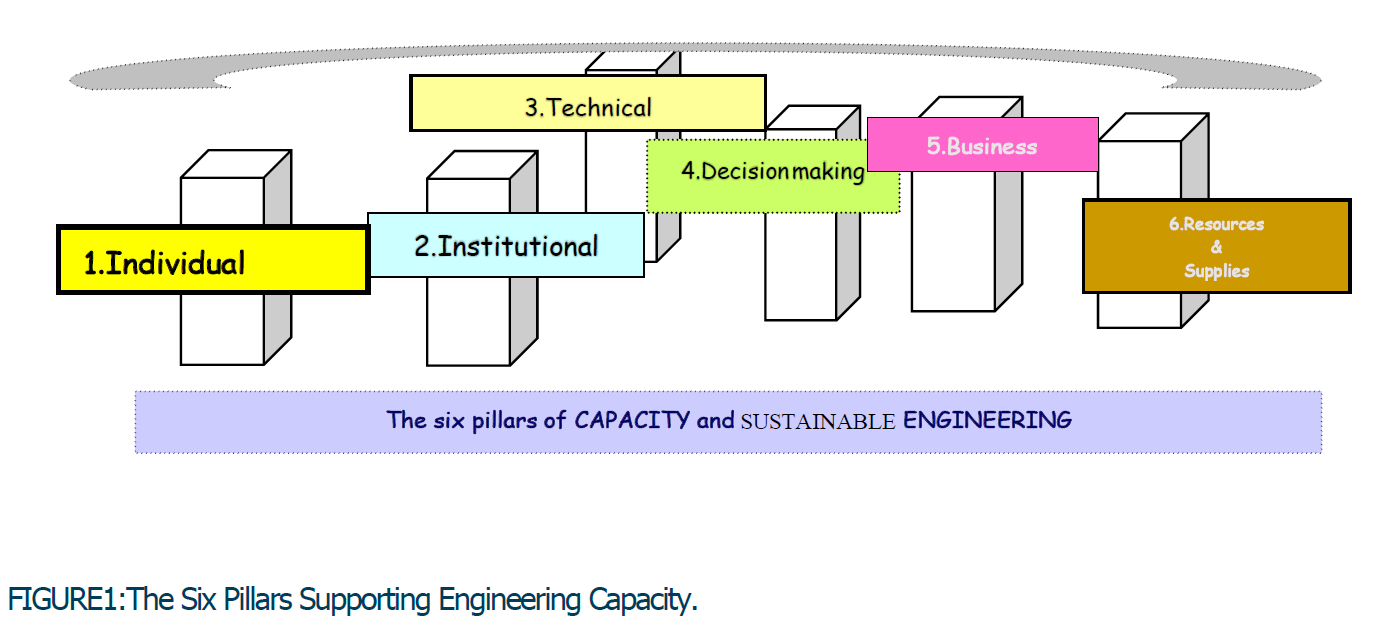
To us capacity building is “a dedication to the strengthening of economies, governments, institutions and individuals through education, training, mentoring, and the infusion of resources. Capacity building aims at developing secure, stable, and sustainable structures, systems and organizations, with a particular emphasis on using motivation and inspiration for people to improve their lives.” The ECZ believes that Sustainable Engineering is a prerequisite for Sustainable Development. The CECB Capacity model is based on the six pillars below. We will craft strategies to achieve the SDGs in a systematic way using the model in figure 1 below.
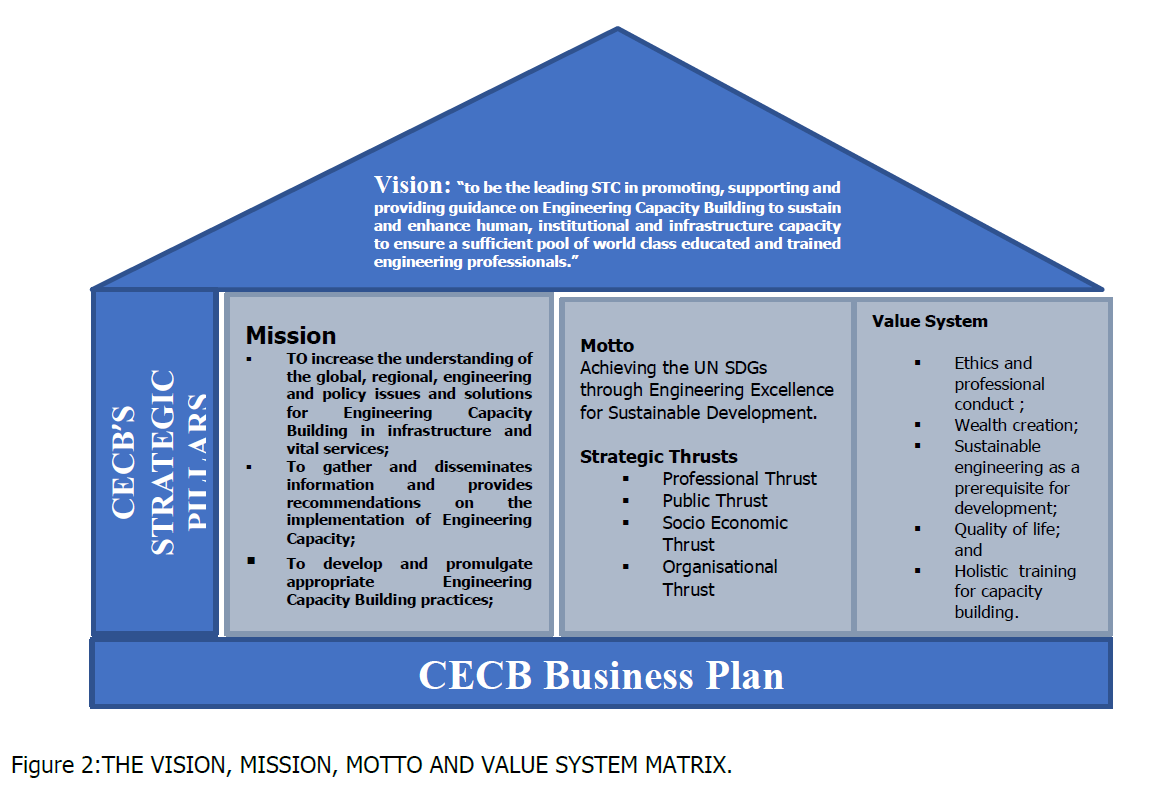
Vision, Motto, Strategic Thrusts, Value System and Mission Statement
The WFEO-CECB Strategic Pillars are shown on the diagram below. CECB aims to be the voice of engineering Capacity Building in WFEO, by being the premier WFEO STC that offers sustainable quality engineering capacity building.
Committee Strategic Objectives
The WFEO-CECB Strategic Objectives are to:
• be recognized as the respected and reliable source of advice and guidance on engineering capacity
building.
• be at the forefront of international engineering capacity building efforts to improve the visibility/
presence, and stature of WFEO, and attain support of National and International engineering
Organizations.
• continuously improve the work and quality of the CECB STC outputs and outcomes for greater
impact and benefit to WFEO membership.
Committee Focus and Deliverables
In partnership with its national members and other WFEO standing committees, the WCEO-CECB will execute a thematic, results-oriented program for 2024-2027 that:
• A new edition of the hand book of engineering capacity building with emphasis on sustainable
development, this will be published and used for training material and may eventually become an
input to UN System Reporting on Engineering Capacity Building.
• Conferences/forums/workshops on engineering capacity building with regional regards in Africa
(together with AEW), Asia (cooperate with FEIAP or CAST or IEI), America (2021 World Engineering Forum or similar event) and Europe (as part of WEC2023).
• Survey of engineering capacity needed for sustainable development, the report of the survey may be an input to next UNESCO Engineering Report or other engineering capacity report.
• Develops and promulgates appropriate Engineering Capacity Building practices in the least developed, developing and developed countries in engineering and related industries;
CECB SDG Focus, Strategic Activities and Deliverables
Goal 16 is our focus goal and it is mainly concerned with building strong institutions and will inform most of our activities. Capacity Building is broad-based so it will have many goals to focus on depending on the project and collaboration on the capacity needed by the other STCs or the partner or WFEO national or international member. For us to continuously improve the work and quality of the STCs outputs and outcomes we will focus on building the capacity of WFEO National and International Members and other STCs to attain the SDGs. SDG 17 will play a supporting role for this STC. Other STC Goals will be supported especially those to with capacity building in engineering standards, infrastructure and education.
Martin Manuhwa, Chair of CECB
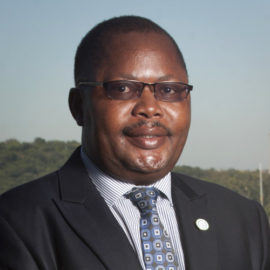
Martin Manuhwa is an electrical and energy consultant engineer and is currently the Managing Director of Zimbabwe Africa Infrastructure Development Group (ZAIDG) a company that specializes in Engineering Procurement and Construction Management (EPCM). His engineering practice is in energy, construction projects, work-site project implementation and management.Martin teaches part time Engineering graduate students at the Zimbabwe National Defense University and has taught MBAs and MBLs at the University of Zimbabwe and Bindura University of Science Education respectively.
His research interest is in the use of Management Information Systems in construction and project management and he is currently a Doctoral Associate at the University of Cape Town where he is researching on the link of ICTs in the Industrial 4.0 Revolution and Productivity in Engineering Projects.
He sits in the advisory Council of the London based Global Infrastructure Anti-Corruption Centre (GIACC). Martin has previously worked for ZESA and Lon-Rho in various capacities in his engineering career. He is the Past President of the Southern African Federation of Engineering Organisations (SAFEO), and also the Zimbabwe Institution of Engineers (ZIE). He is the immediate past President of the Federation of African Engineering Organisations.
Activities
Members
Members list
| Member | WFEO National Member / Institution | Country / Region |
| Abdeljalil Nadif | Union National des Ingénieurs Marocains | Morocco |
| Ahmed Jassim Al Golo | Federation of Arab Engineers | International |
| Amable Esparza | Instituto de la Ingeniería de España | Spain |
| Ambasi Roselane Mbone | Institution of Engineers of Kenya | Kenya |
| Ana Patricia Fernández-Getino | Instituto de la Ingeniería de España | Spain |
| Anisa Valigy | Ordem dos Engenheiros de Moçambique | Mozambique |
| Benjamin Osita Okoh | Nigerian Society of Engineers | Nigeria |
| Catarina Monteiro | Ordem of Engineers of Angola | Angola |
| Charles Adams | Ghana Institution of Engineering | Ghana |
| Cheung Lai King Carlei | Macau Institute Of Engineers | Macau, SAR of China |
| Chloé Andriamihaja | Ingénieurs et Scientifiques de France | France |
| Christine Adongo Ogut | Institution of Engineers of Kenya | Kenya |
| Daniel Kukaras | Serbian Chamber of Engineers | Serbia |
| David Zohar | Engineers Australia | Australia |
| Dragan Zivkovic | European Council of Civil Engineers (ECCE) | International |
| Dragoslav Sumarac | Serbian Chamber of Engineers | Serbia |
| El Hassan El Mokhi | Union National des Ingénieurs | Morocco |
| Eva KONG | Hong Kong Institution of Engineers | Hong Kong, SAR of China |
| HE Jing | China Association for Science and Technology | China |
| Hussain Falih Mahdi | Iraqi Engineers Union | Iraq |
| Ivan Traverso | Peruvian Engineers Association | Peru |
| Jemal Jibril | Ethiopian Association of Civil Engineer | Ethiopia |
| José Manuel Sousa | Ordem Engenheiros Técnicos | Portugal |
| Joseph Abdallah | Federation of Lebanese Engineers | Lebanon |
| Lai Weng Kuong (Franco) | Macau Institute Of Engineers | Macau, SAR of China |
| Manda Satchishinga | Ordem of Engineers of Angola | Angola |
| Martin Manuhwa (Chair) | Engineering Council of Zimbabwe | Zimbabwe |
| Milena Cojbasic | Engineers Chamber of Montenegro | Montenegro |
| Muhammad Tofazzal Hossain | Institution of Engineers, Bangladesh | Bangladesh |
| OUYANG Zheng | China Association for Science and Technology | China |
| Paul Jowitt | Commonwealth Engineers Council | International |
| Ross Kristinof | Engineers Australia | Australia |
| Samar Kilani | Jordan Engineers Association | Jordan |
| Shafiul Azam | Institution of Engineers, Bangladesh | Bangladesh |
| U Lin | Myanmar Engineering Society | Myanmar |
| Venuste Twagiramungu | Institution of Engineers Rwanda | Rwanda |